You asked
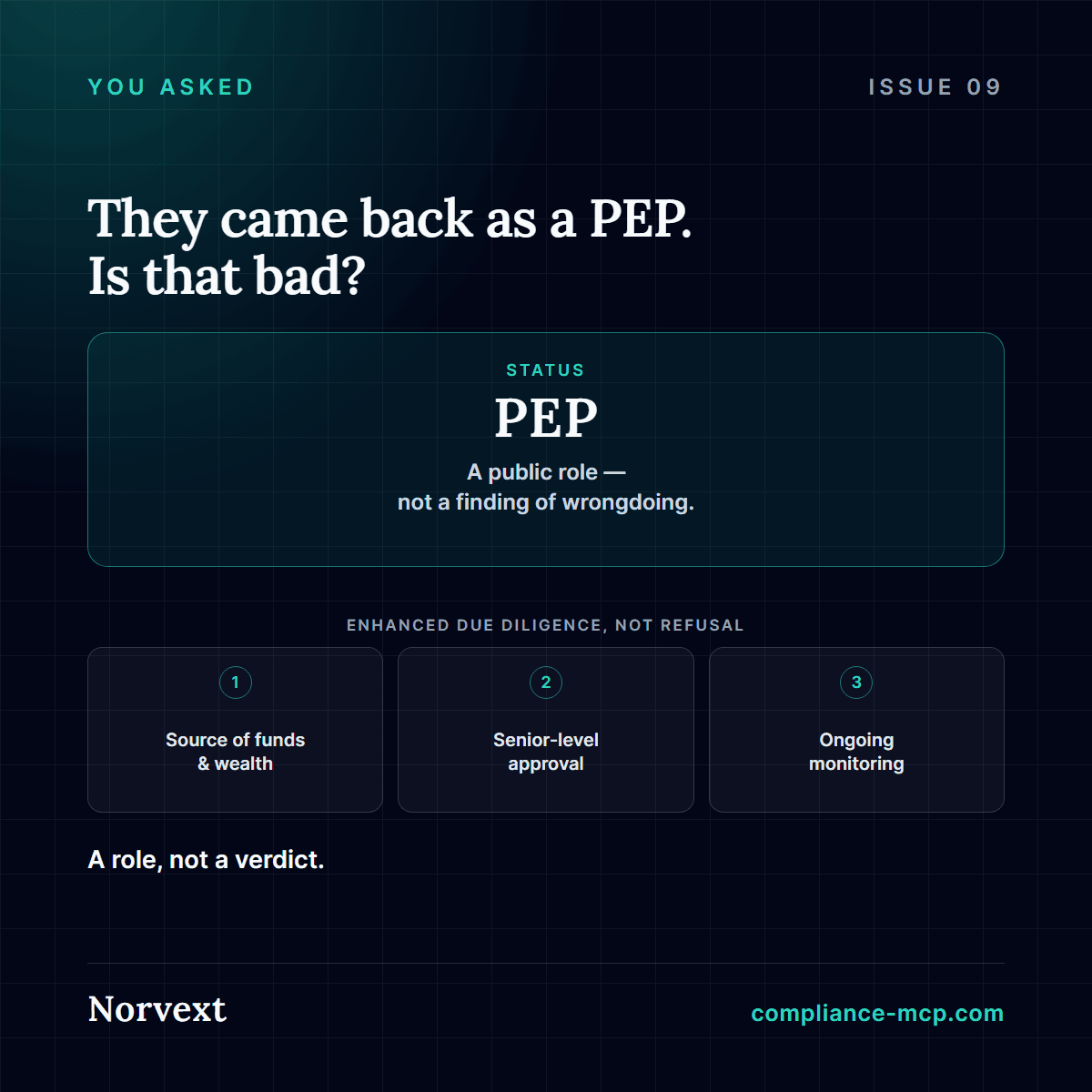
No. A PEP match means the person holds, or recently held, a prominent public position — a member of parliament, a minister, a head of state, a senior judge. That's an exposure signal: people in those positions are statistically more exposed to bribery, embezzlement and undue influence, so regulators want closer scrutiny. It is not a finding of wrongdoing, and treating it as one — refusing the relationship outright — is exactly the failure mode financial supervisors have called out by name. The compliance question isn't "how do I say no," it's "what do I need to see before I can responsibly say yes."
A role, not a verdict
PEP status attaches to an office, not to a person's character. FATF and the EU AML framework define it around function — head of state or government, senior politician, senior official of a political party, senior judicial or military official, senior executive of a state-owned enterprise, senior official of an international organisation — plus their immediate family and known close associates. None of that is an accusation. It's a proxy: people who control public budgets, appointments or regulatory decisions are, as a class, more exposed to bribery and embezzlement risk than the general population, so the rulebook asks for a closer look before you take them on as a client, not a closed door.
Status also isn't permanent, and it doesn't vanish the day someone leaves office. FATF and the EU's AML directives apply a grace period — typically twelve months after leaving a covered position — during which the person is still screened as an active PEP before the status can lapse to "former." A minister who resigned last month is not, compliance-wise, a clean slate yet.
Where blanket rejection goes wrong
"De-risking" — refusing an entire category of customer rather than assessing them individually — is not a cautious compliance posture; it's a documented one. FATF's own PEP guidance and the EU's risk-factor guidelines both push back on it explicitly: a risk-based approach means graduated scrutiny proportional to actual exposure, not a blanket ban on an entire class of legitimate customers because one member of that class might be a problem.
The people this actually hits are elected officials, civil servants, and — because family counts — their spouses and children, none of whom chose to be statistically higher-risk by taking a job that serves the public. Refuse them wholesale and the predictable result is that they move their banking to less scrutinised channels, which is the opposite of what the rule was built to achieve.
What enhanced due diligence actually asks for
A PEP match triggers Enhanced Due Diligence, not a refusal — and EDD has a concrete shape, not a vague "be careful." Three things: establish the source of funds and source of wealth (where the money in the relationship actually comes from, not just what the client states), get senior management approval before establishing or continuing the relationship, and apply ongoing enhanced monitoring for as long as the exposure lasts, not a one-time check at onboarding.
Run the PEP check alongside sanctions screening, not instead of it — the two answer different questions. A person can be a sanctioned criminal with no public office at all, a squeaky-clean PEP with zero sanctions exposure, both, or neither. Political exposure and sanctions status are independent facts about the same name.
Before you act on a PEP match
- PEP is an EDD trigger, not a sanctions block — never refuse a relationship on a PEP hit alone
- "Former" still carries a grace-period tail — FATF/AMLD apply roughly twelve months of continued PEP treatment after someone leaves office
- EDD means three concrete steps: source of funds/wealth, senior-level sign-off, ongoing enhanced monitoring — not a one-time check
- Screen for PEP and sanctions separately — they're independent signals about the same person