You asked
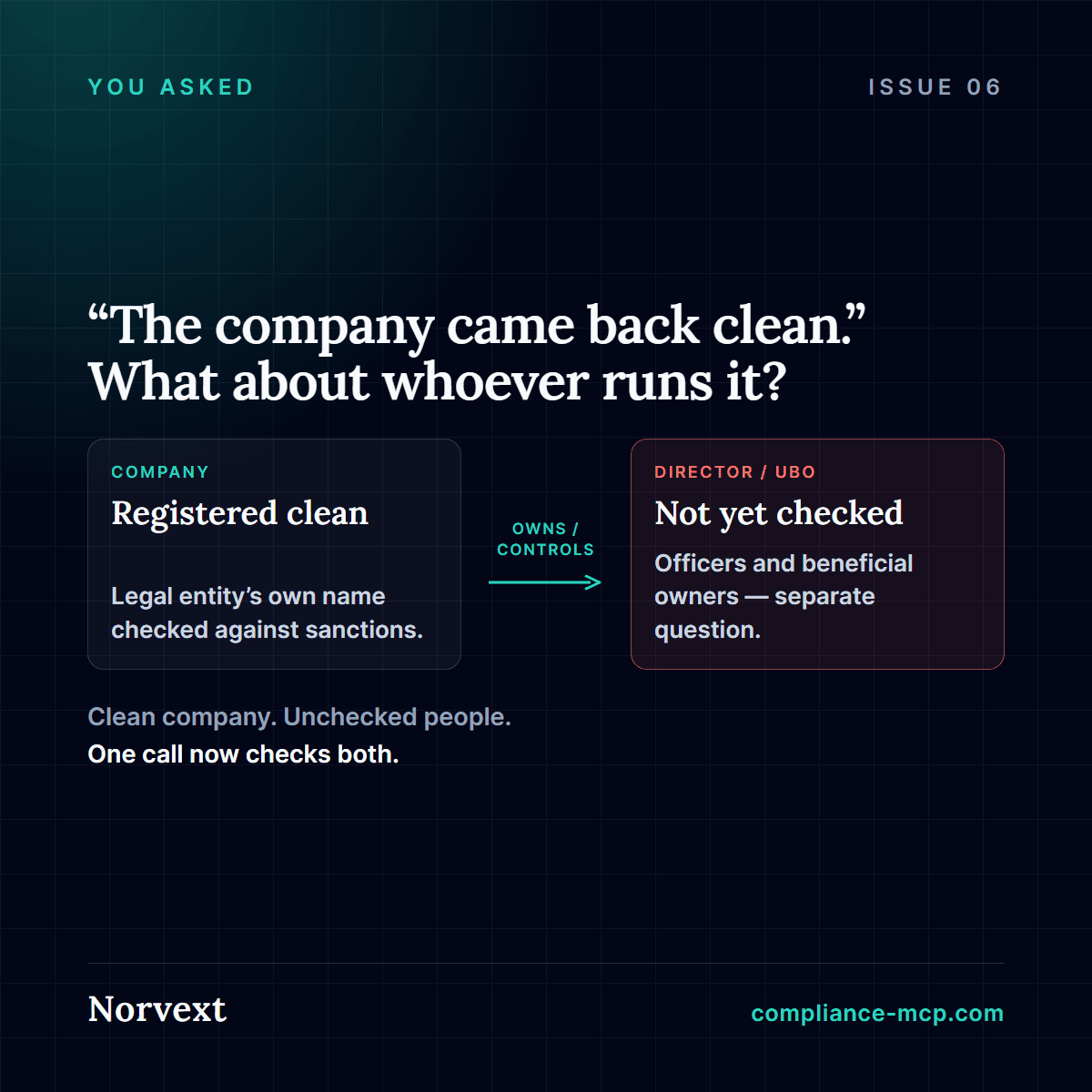
Nothing, unless it’s checked separately. Sanctions lists are full of people who control a company without the company itself ever appearing on a list — ownership and control are exactly the structure sanctions regimes are designed to reach through. Resolving a company from an official registry, pulling its officers and beneficial owners, and screening the company plus every one of those people is now one call, not a manual multi-step research project.
Why a clean company isn’t the whole answer
This one came in almost word for word from an onboarding team, and it deserves the direct answer it’s asking for. A standard entity screen checks one name: the legal entity’s own registered name, against sanctions and end-user lists. It has no way to know who owns or directs that entity unless that information is supplied as part of the same query — and a company’s own registered name almost never carries its ownership structure.
This is precisely the gap sanctioned individuals use, deliberately or not: control a clean-looking company, and a screening process that stops at the company name never reaches you.
What resolving a company from a registry actually gives you
Looking up a real, ordinary company — a major Baltic bank, in the Latvian company register — returns the full registered profile in under a second: registration number, incorporation date, legal status, and a history of related registrations. Latvia, Estonia, Kazakhstan and Poland are covered today, Poland currently by exact registry number.
That profile alone is reference evidence, not a clearance — the useful step is what comes next.
Company plus the people behind it, in one call
One combined check resolves the company from the registry, pulls its officers and beneficial owners from the official source, and screens the company itself plus every one of those named people against sanctions — returning a single aggregate decision rather than a company result and a pile of names still waiting to be checked one by one. Officers and beneficial owners are included by default; shareholders are available too, depending on what the registry actually publishes.
The aggregate decision names which specific person, if any, triggered the review — not just “the company” with an asterisk.
What a complete counterparty check actually covers
- A clean company-name screen answers one narrow question: is this legal entity itself listed
- Ownership and control are a separate question a company-name check cannot answer on its own
- Resolving officers and beneficial owners from an official registry is now part of the same workflow, not a second research task
- The aggregate decision should name which specific person, if any, triggered the review