You asked
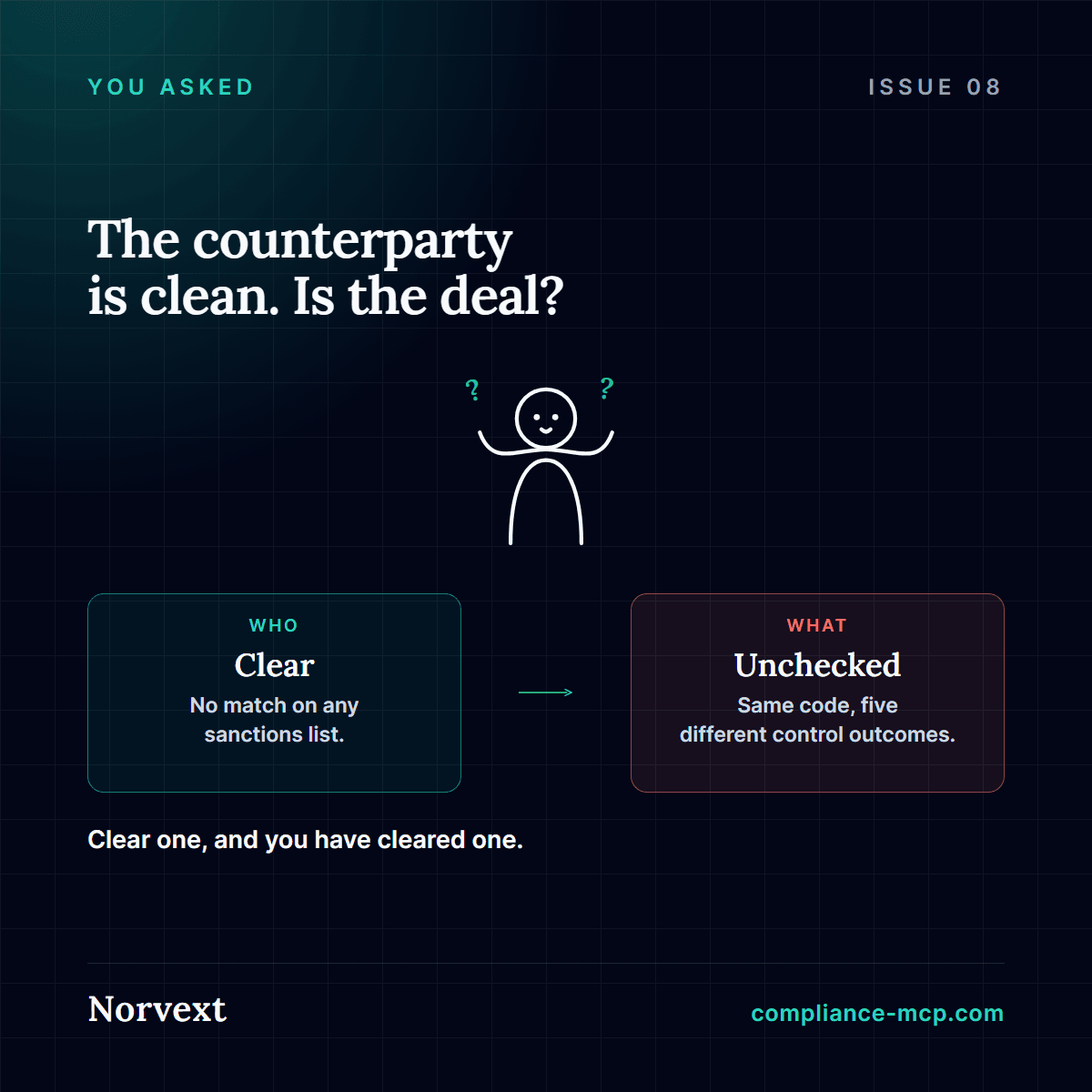
Sanctions compliance runs on two independent checks: WHO you're dealing with, and WHAT you're shipping them. A spotless counterparty screening result closes the WHO question and says nothing about the WHAT question. The same CN/TARIC code can cover an ordinary commercial part with zero export controls and a radiation-hardened or cryptography-enabled variant that needs a licence—the code alone doesn't tell you which one you're holding. Clear the buyer, and you have cleared the buyer.
Two checks, not one
Counterparty screening asks whether a name—person, company, vessel, bank—appears on a sanctions, PEP, or debarment list. Goods screening asks whether the item itself is restricted for that destination, end-use, or end-user, independent of who's buying it. They run against different data (entity lists versus classification and control regimes), and they can return opposite answers on the same transaction: a wholly unlisted buyer, in a country under no embargo, can still be legally barred from receiving a specific part.
Treating a clean WHO result as a green light for the whole deal collapses two separate legal tests into one. Both have to clear independently, because a match on either one is enough to make the shipment illegal.
Where a clean counterparty still fails
Take CN 8542, electronic integrated circuits. An ordinary commercial chip under that code carries no export controls at all—EAR99, ship it anywhere. A radiation-hardened variant under the same code range falls under EU Dual-Use Annex I entry 3A001. A general-purpose computing part with enough performance lands under 3A991. Add cryptography and it's 5A002. A military-designed version sits under EU Common Military List entry ML11. Five wildly different legal outcomes, one CN code.
What separates them isn't the buyer—it's radiation hardening, performance grade, temperature range, whether encryption is present, and the end-use. None of that is visible in a counterparty screening result, because counterparty screening was never designed to answer it.
Reading a partial code
A CN/TARIC code isn't a lookup key with one answer attached—it's a starting point for a classification decision, and the digits that actually decide control status are often the ones that get truncated. Four digits gives you a product family; eight or ten digits, plus the technical spec sheet, is what a control regime actually keys off. Read a shortened code as the range of things it could mean, not as a verdict.
That's also why an export-control signal is a candidate for review, not an automatic pass or block. The workable sequence is: CN/TARIC narrows the field, product characteristics narrow it further, the applicable control-list rule gets checked against those characteristics, and a person confirms the outcome. Skipping straight from "code looks fine" to "shipment is clear" skips the three steps that actually carry the legal weight.
Before you call a shipment clear
- A clean counterparty result answers WHO, not WHAT—screen the goods separately
- The same CN/TARIC code can span controlled and uncontrolled goods; technical specs decide, not the code alone
- A truncated code is a range of possibilities, not a final answer
- Treat an export-control match as a candidate for review, not an automatic block or a pass